Tasmania has a well-earned reputation for wilderness, world-class art, and dramatic scenery that photographs extremely well.
Nobody argues or refutes that reputation. Instead, what tends to get left out of it, though, is the north: the part with the working farms and the river valleys and the cave full of glow worms and the tree park where wild platypus surface in the middle of the day.
North Tasmania has a lighthouse that has been doing its job since 1889, caves discovered by accident in 1906, and a collection of farms and river valleys.
The Part of the Island That Grows Things for a Living
Devonport sits at the top of Tasmania, where the Mersey River meets Bass Strait. It is a port town that operates like a port town. Waterfront, cafes, and a reasonable amount of activity around the ferry terminal. It serves as the practical entry point for the north coast.
Inland from there, things settle into farmland. The Kentish Range rises in the background. Mt Roland sits at the back of the frame, long and flat-topped. Small towns occupy the valleys between the hills. Fourth, Spreyton, Sheffield. Each with their own logic, their own bakery, their own patient sense of time. The farming here is working farming. Orchards, paddocks, horses in fields alongside rivers that run clean and cold.
On Slowing Down Without Trying
The pace of the place works against urgency in a way that feels more like the landscape making a reasonable suggestion. A morning on the Forth Riverbank watching a horse watch you from across a fence is not a wasted morning. It is, in its own way, exactly what a weekend is for.
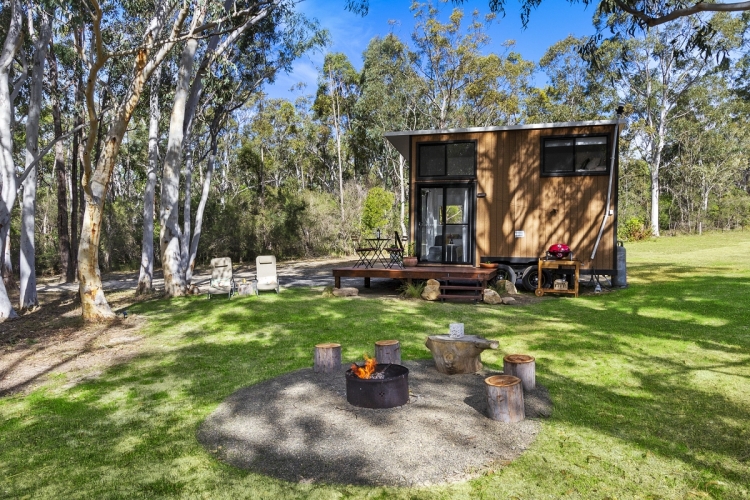
The tiny houses along this stretch of coast amplify that effect considerably. A property with a deck and a mountain view operates differently from a hotel room. You return to it at the end of the day as a place.
Three Things Worth Doing in North Tasmania
The Tasmanian Arboretum
Most visitors find out about the Tasmanian Arboretum from a leaflet at the visitor centre. This is one of the least glamorous discovery methods available. It also, in this case, leads somewhere genuinely worth going.
The Arboretum spans 66 hectares of botanical tree park set in a valley outside Devonport. Over 4,900 plants are arranged across geographic collections representing the temperate world. Gondwana descendants, Southern Hemisphere conifers, Tasmanian woody flora. About 80 bird species have been recorded on the site. The kiosk serves coffee and Tasmanian ice cream at reasonable prices.
The main reason is Founders' Lake, which is widely regarded as one of the most reliable places in Australia to see wild platypus. Actually watch them surface, dive, and go about their own business in the middle of the day.
The Limestone Heritage Walk connects the geology to a century of colonial and early Federation history in a way that earns its signage rather than just occupying it. Open every day of the year.
Mersey Bluff Lighthouse
The Mersey Bluff Lighthouse has stood at the mouth of the Mersey River since 1889. It is 16 metres tall with four vertical red stripes. It is not open to the public because it still functions as a working navigational aid and has a job to do.
The surrounding reserve is open, and that is where the visit happens. A coastal loop walk takes visitors around the bluff with Bass Strait on one side and the river mouth on the other. The rocks near the base hold Aboriginal petroglyphs, carvings of abalone, crayfish, a seal, and an emu, that predate the lighthouse by a significant margin.
Gunns Plains Caves
The caves were discovered in 1906 when a hunter named Bill Woodhouse watched a possum escape down a hole in the ground and, to his credit, followed up on it. The original entrance required a rope to descend. There are now 54 concrete steps, which represent meaningful progress.
A guided tour takes visitors 275 metres into the cave through limestone chambers containing calcite shawls, flowstone formations that look like something left to melt near a heat source, and an underground river that still flows and still carries giant freshwater lobsters and eels through the dark.
Glow worms line the ceiling of the Brodies tunnel, casting a faint bioluminescent light across the rock that is, even for people who do not typically describe things as magical, fairly magical. Platypus nest in the sandy banks along the river, though the cave is not where you will see them. The guides are good company. The cave is comfortably cool and quiet year-round. Six tours run daily between 10 am and 3:30 pm. Remember to wear shoes with some grip.
What Stays With You
What north Tasmania does is accumulate. Not in a way that announces itself, but more like the way a good conversation stays with you. The air off the strait has a particular quality to it. The farms in the Forth Valley sit in their paddocks as though the idea of being somewhere else has never occurred to them.
The platypus at Founders' Lake surfaces when it feels like it, dives when it feels like it, and pays no attention to anyone watching from the bank, which is, honestly, a reasonable approach to life.
None of the places here asks a great deal of you. The caves, the lighthouse, the arboretum. Turn up at your own pace, and you leave having seen something that has been there for a very long time. The north coast of Tasmania rewards the kind of travel where slowing down is the whole plan, and it does so generously.
Where to Stay
Hillside Hideout by Tiny Away
Hillside Hideout sits on a working farm in West Kentish with uninterrupted views of Mt Roland, Mt Claude, and Mt Van Dyke from the deck. The ridgeline sits at the back of the property and, over a day or two, becomes reassuring in a way that is easy to understand once you are standing in front of it.
The tiny house is self-contained and well-considered, about 30 minutes from Devonport and within comfortable reach of Sheffield and the cave country to the south. The deck faces a view that makes the morning coffee take longer than planned; a totally reasonable trade.
Perrys North and Perrys South by Tiny Away
Both Perrys' properties sit on a working farm in Forth, ten minutes from Devonport, with 500 metres of private Forth Riverbank that belongs to guests and essentially nobody else.
Perrys North and Perrys South are companion tiny houses on the same property, each self-contained and designed for two guests. The riverbank is for sea-run trout fishing if that is something you do. Horses occupy the adjacent paddocks. The Tasmanian Arboretum, the lighthouse, and Gunns Plains Caves all sit within comfortable range. These are properties for people who want the quiet of farming without giving up access to everything the north coast has to offer.
Book your north Tasmania tiny house with Tiny Away and come find out what the island looks like when the ferry is already behind you.
¹ Dining note: Blue Gum Bush Farm (3 Story St, St Marys TAS 7215) sits east of Devonport and is more of a deliberate detour than a short drive, but worth building into a longer Tasmania itinerary. Use code BLUEGUMBUSH2025 for 10% off meals.
/960x720/uploads/2026/03/262/jpeg1774927246955.jpeg)
/960x720/uploads/2026/03/262/jpeg1774927245846.jpeg)
/960x720/uploads/2026/03/262/jpeg1774927246052.jpeg)
/960x720/uploads/2026/03/262/jpeg1774927246327.jpeg)
/960x720/uploads/2026/03/262/jpeg1774927246737.jpeg)
/960x720/uploads/2026/03/262/jpeg1774927247690.jpeg)
/960x720/uploads/2026/03/262/jpeg1774927248387.jpeg)
/960x720/uploads/2026/03/262/jpeg1774927250793.jpeg)
/960x720/uploads/2026/03/262/jpeg1774927252935.jpeg)
/960x720/uploads/2026/03/262/jpeg1774927255315.jpeg)
/960x720/uploads/2026/03/262/jpeg1774927255559.jpeg)
/960x720/uploads/2026/03/262/jpeg1774927255746.jpeg)
/960x720/uploads/2026/03/262/jpeg1774927257775.jpeg)
/960x720/uploads/2026/03/262/jpeg1774927260876.jpeg)
/960x720/uploads/2026/03/262/jpeg1774927261251.jpeg)
/960x720/uploads/2026/03/262/jpeg1774927264143.jpeg)
/405x405/Listings/Images/2026/02/874/guesty_6989b4fe22b9b1.770193541770632446247.jpg)
/405x405/Listings/Images/2026/02/874/guesty_6989b4fea2ead6.982804191770632447087.jpg)
/405x405/Listings/Images/2026/02/874/guesty_6989b4ff7cfa24.881707081770632447678.jpg)
/405x405/Listings/Images/2026/02/874/guesty_6989b500117301.875997171770632448152.jpg)

/405x405/Listings/Images/2026/02/909/guesty_69818b2041f732.698236721770097440519.jpg)
/405x405/Listings/Images/2026/02/909/guesty_69818b2a391477.132146651770097450318.jpg)
/405x405/Listings/Images/2026/02/909/guesty_69818b24a7b131.104883341770097444986.jpg)
/405x405/Listings/Images/2026/02/909/guesty_69818b25549798.344507641770097445511.jpg)
/405x405/Listings/Images/2026/02/948/guesty_697ffea0d66a75.699450001769995937051.jpg)
/405x405/Listings/Images/2026/02/948/guesty_697ffea1659971.372948581769995937586.jpg)
/405x405/Listings/Images/2026/02/948/guesty_697ffea1e71402.334356911769995938266.jpg)
/405x405/Listings/Images/2026/02/948/guesty_697ffea298e888.424956731769995938870.jpg)


/Merchant/Image/2025/12/jpg1766004869284.jpg)