/405x405/Listings/Images/2026/02/24/guesty_6989b55ab50791.289757451770632539135.jpg)
/405x405/Listings/Images/2026/02/24/guesty_6989b572153ce9.780119541770632562243.jpg)
/405x405/Listings/Images/2026/02/24/guesty_6989b5707613f3.717569881770632560682.jpg)
/405x405/Listings/Images/2026/02/24/guesty_6989b57136f357.156831931770632561520.jpg)
/405x405/Listings/Images/2026/02/32/guesty_6989b59ba273a7.591969551770632603878.jpg)
/405x405/Listings/Images/2026/02/32/guesty_6989b59c718125.164802341770632604672.jpg)
/405x405/Listings/Images/2026/02/32/guesty_6989b5a5b14032.148392771770632613924.jpg)
/405x405/Listings/Images/2026/02/32/guesty_6989b5a67ff313.038955611770632614719.jpg)
/405x405/Listings/Images/2026/02/488/guesty_6989b6a14aa755.034677831770632865331.jpg)
/405x405/Listings/Images/2026/02/488/guesty_6989b6a5ddd080.447775231770632869932.jpg)
/405x405/Listings/Images/2026/02/488/guesty_6989b6a6472ae5.218559621770632870321.jpg)
/405x405/Listings/Images/2026/02/488/guesty_6989b6a2140831.456419911770632866100.jpg)
/405x405/Listings/Images/2026/02/944/guesty_6989b6dcd2d032.989401531770632924884.jpg)
/405x405/Listings/Images/2026/02/944/guesty_6989b6dd3babf3.842142961770632925262.jpg)
/405x405/Listings/Images/2026/02/944/guesty_6989b6dd956714.369545081770632925637.jpg)
/405x405/Listings/Images/2026/02/944/guesty_6989b6ddeffe50.031288141770632926008.jpg)
/405x405/Listings/Images/2026/02/963/guesty_697fffe207d715.704048401769996258049.jpg)
/405x405/Listings/Images/2026/02/963/guesty_697fffe2634a27.671559301769996258527.jpg)
/405x405/Listings/Images/2026/02/963/guesty_697fffe2d59a64.685419001769996258928.jpg)
/405x405/Listings/Images/2026/02/963/guesty_697fffe3419a75.330933181769996259323.jpg)
OUR ADVENTURE MAP
Where we stayed
We've plotted our adventure on the map below. Select the map icons to discover more details.

/960x720/upload/2026/07/273/png1784561364709.png)
Canberra's tourist maps end abruptly at the city limits, as if the roundabouts and the parliamentary triangle were the whole story.
Drive twenty minutes past the lake, and the landscape turns into paddocks rolling toward distant ridgelines, cool climate vineyards tucked into valleys, and wind turbines above Lake George catching the day's last light.
Where Farmland Meets the Foothills of the Capital
The towns scattered around Canberra's edges have never needed the city to justify themselves. Bungendore has lived its reputation on woodworking and wine long before day trippers discovered it.
Yass has been a coaching stop and pastoral hub since the 1800s, its bluestone buildings still doing quiet work along the main street. Wamboin trades almost entirely in vineyards and native bushland, with barely a hint that Canberra's CBD sits half an hour down the road. They simply carry on with sheep, grapes, and seasonal rhythms, and visitors who show up get to witness the genuine article.
Authenticity extends into the wine itself. The Canberra District is also known for cool-climate varietals, particularly Riesling and Pinot Noir, grown on elevated sites such as the shores of Lake George.
Lerida Estate, sitting at the base of the Cullerin Range near Lake George, has been producing wine since the first vines were planted in 1997. They work with minimal intervention techniques, including wild yeast fermentation, to build complexity into their Pinot Noir. The winery building itself, designed by acclaimed architect Glenn Murcutt in 2005, was conceived to complement the surrounding landscape.
Ten kilometers away, the historic township of Collector adds a café, a pub, a produce market, and an art gallery to the itinerary, all accessible off the Federal Highway without much detour required.
The Art of Arriving With Nowhere to Be
There's a particular adjustment period for guests who trade a hotel room in central Canberra for a paddock on the region's edge, and it typically takes about a day.
City habits die hard: the instinct to check a phone every few minutes, to plan the next three hours down to the minute, to treat quiet as something to fill. Out here, that instinct loses its grip fairly quickly. Cattle move at their own pace regardless of anyone's schedule. Fog rolls off Lake George most mornings and burns away by mid-morning without any input from the people watching it. Vineyards ripen on a calendar that has nothing to do with checkout times.
What replaces the urgency is something harder to package into a brochure but easy to recognize once it arrives: a kind of attentiveness to small things, a sunset over vine rows, a horse working its way along a fence line, the particular silence of a countryside evening.
Locals have known this for generations. Visitors usually need a night or two before they catch on, which is precisely why an overnight stay does more for the trip than a day pass ever could.
What to See Between Vineyards and Valleys
The National Arboretum Canberra anchors any visit to the region's cultural side. The site holds 94 forests planted with rare, endangered, and symbolic tree species drawn from Australia and around the world. It doubles as home to the National Bonsai and Penjing Collection, pairing large-scale landscape design with intricate, close-up botanical work in a single visit.
The Australian National Botanic Gardens takes a narrower but no less compelling focus, dedicating its grounds entirely to native flora. Shaded trails wind beneath eucalypt canopy, and the Rainforest Gully walk drops the temperature by several degrees compared to the car park, a welcome surprise on a warm afternoon. Birdsong tends to outnumber footsteps here, particularly on weekday mornings.
Mount Ainslie Lookout offers the clearest orientation point in the entire region, laying out Lake Burley Griffin, Canberra's parliamentary triangle, and the distant mountain ranges in a single sweeping view. Locals favor it at both ends of the day, when the light does its best work, and the short drive up makes it an easy addition to a morning or evening itinerary.
Wine enthusiasts will find plenty to extend the day further. Cellar doors scattered through Murrumbateman, Lake George, and Wamboin range from long-established estates to newer ventures still building their following, and most sit within easy reach of the tiny houses covered below.
The Case for Sleeping Outside the City Limits
Guests deciding between a hotel room downtown and a tiny house on the region's edge usually reach the same conclusions once they weigh the options.
Space multiplies without the price tag climbing. A hotel room offers four walls and a view of a car park. A tiny house on a working property comes attached to paddocks, dams, and unbroken sky, at no premium charged for any of it.
The wildlife is resident. Cattle, sheep, horses, peacocks, and free-ranging chickens live on these properties year-round. Guests who want to lend a hand with small farm tasks can, and those who'd rather observe from a distance are equally welcome to.
The commute stays honest. Every property on this list sits within thirty to fifty minutes of central Canberra, close enough for a gallery visit in the morning and a paddock walk at dusk on the very same day.
What Guests Carry Home
Ask past guests what stayed with them longest, and the answer don’t usually match whatever attraction anchored the itinerary.
It's usually something smaller: the particular hush of a countryside evening, a horse approaching the fence out of curiosity, a dam catching the day's last light.
Canberra supplies the culture, the history, and the gardens worth the detour. The countryside surrounding it supplies something considerably harder to book anywhere else: the feeling of having spent time somewhere.
Where to Stay: Three Tiny Houses, Three Ways Into the Region
Rae, Edgar and Baxter at Lake George Winery by Tiny Away
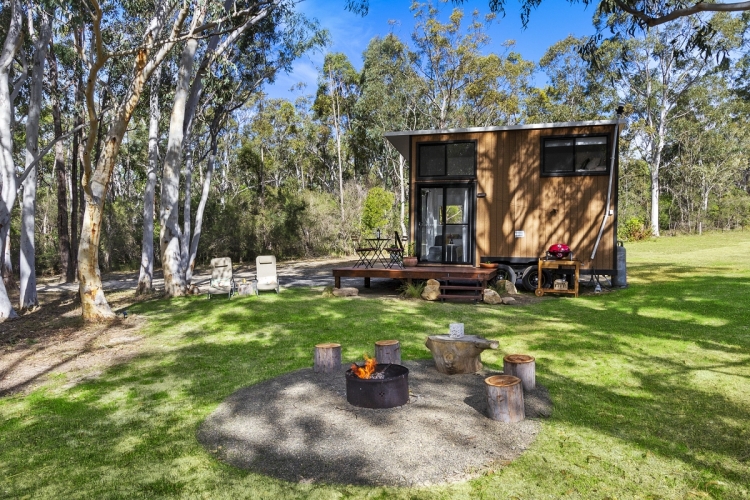
Positioned near Bungendore with the Lake George wind turbines visible on the horizon, this property puts guests within easy striking distance of the region's wine country while keeping the paddocks and the tranquility close at hand.
Beckford Tiny House 1 & 2 by Tiny Away
A working farm stay in Good Hope, roughly a fifty-minute drive from Canberra, sharing its paddocks with cattle, sheep, horses, and peacocks. Murrumbateman's wineries and the natural attractions around Wee Jasper both sit within reach for day trips, alongside easy access back to the National Arboretum and Cockington Green Gardens.
Aranya Acres by Tiny Away
Set in Wamboin, roughly thirty minutes outside Canberra, on land bordering the Aranya Acres winery and restaurant, this property pairs vineyard views by day with dark, unpolluted skies once the sun goes down.
Three distinct approaches to the same countryside, each one close enough to Canberra for a proper day of sightseeing, and each one far enough removed to deliver a stay that earns the word escape.
/960x720/upload/2026/07/273/png1784561365004.png)
/960x720/upload/2026/07/273/png1784561367016.png)
/960x720/upload/2026/07/273/png1784561366902.png)
/960x720/upload/2026/07/273/png1784561366527.png)
/960x720/upload/2026/07/273/png1784561366399.png)
/960x720/upload/2026/07/273/png1784561366281.png)
/960x720/upload/2026/07/273/png1784561366162.png)
/960x720/upload/2026/07/273/png1784561366034.png)
/960x720/upload/2026/07/273/png1784561365418.png)
/960x720/upload/2026/07/273/png1784561365174.png)
/960x720/upload/2026/07/273/png1784561362702.png)
/960x720/upload/2026/07/273/png1784561364567.png)
/960x720/upload/2026/07/273/png1784561364167.png)
/960x720/upload/2026/07/273/png1784561363955.png)
/960x720/upload/2026/07/273/png1784561363795.png)
/960x720/upload/2026/07/273/png1784561363589.png)
/960x720/upload/2026/07/273/png1784561363183.png)
/960x720/upload/2026/07/273/png1784561362910.png)
We've plotted our adventure on the map below. Select the map icons to discover more details.